Australia's Top Ten Dangerous Animals
|
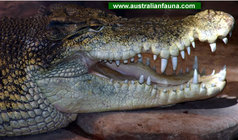
Saltwater Crocodile (Crocodylus porosus) (The World's Largest Reptile)
The Saltwater Crocodile is the world's largest reptile. These amazing creatures are found on the northern coast of Australia and inland for up to 100 kms or more. The Saltwater Crocodile has been reported to grow to lengths of 7 metres!, but the average size of a Saltwater Crocodile is 4 metres long. They reproduce in the wet season, with the female crocodile laying up to 60 eggs at a time. When the crocodiles are born, only a very small number of these survive in the wild and grow to be adult crocodiles. |
|
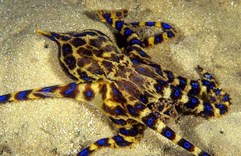
Blue Ring Octopus
The Blue Ring Octopus is a deadly venomous octopus which inhabits warm waters and shallow reefs off the coast of Australia. It also lives off the coast of New Guinea, Indonesia and the Phillipines. This octopus has distinctive blue rings (hence its name) on its body and eight tentacles. With the tentacles spread, it is about 20 cms in diameter. It feeds on small sea creatures, and wounded fish. Amazing Fact: If an octopus loses a tentacle, they can regenerate and grow a new one. |
|
|
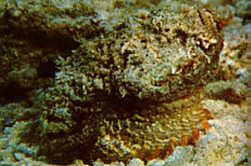
The Stonefish is another of Australia's deadly marine creatures. They inhabit shallow waters along the coast. The stonefish is well camouflaged in the ocean, as it is a brownish colour, and often resembles a rock. This is why it is called the Stonefish.
It has thirteen sharp dorsal spines on its back, which each have extremely toxic venom. Amazing Animal Fact: The venom of a stonefish can kill a human in two hours. People swimming in the ocean need to take care, as they can unknowingly step on a Stonefish and have venom injected into their foot. The stonefish feeds on other small fish or shrimp. |
|
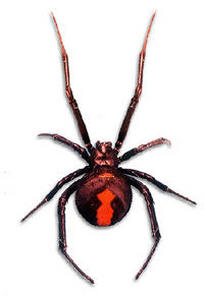
The Red Back Spider is Australia's most well known deadly spider. They are found all over Australia, and are common in urban areas. The Black Widow Spider (found in the USA) is a close relative of the Red Back. These spiders are usually found under logs, rocks, bricks, sheds and outdoor toilets.
The Red Back Spider feeds on insects, but can take down small lizards and crickets. These spiders are small in size, the females being about 1cm long and the males about 4mm long. Amazing Fact: Only the female red back spider bite is dangerous to humans. |
|
|
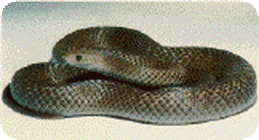
The brown snake is approximately 1.5 metres long, and is one of Australia's more deadly creatures. They have venom which can cause death to humans relatively quickly if left untreated. Brown snakes up to 2.3 metres have been recorded in Australia.
They feed on small creatures, such as mice and rats, small birds, lizards or even other snakes. These snakes are found in Eastern Australia, however they are not found in Tasmania. |
|
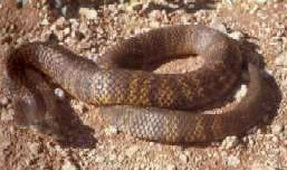
The common tiger snake is found in southern and eastern Australia. They are usually around a metre long, and have a striped marking (hence the name Tiger Snake). This is not always the case however, as the markings can change due to the seasons and the age of the snake. They can grow up to 1.5 metres in length.
These are venomous snakes, and will attack if they are disturbed or threatened. Otherwise, they can live quietly. They are also often territorial, and will live in the same area for years. They are also found in suburban areas, even in the newer suburbs. One elderly women was bitten by a tiger snake while she pruned the ivy on her fence, in Kew (an inner suburb of Melbourne, in 2003). Death resulted from this bite. However this is quite rare these days, as anti venene is readily available. These snakes feed on all types of creatures, they happily feed on frogs, fish, small birds and other small mammals. They also eat other reptiles such as lizards. |
|
|
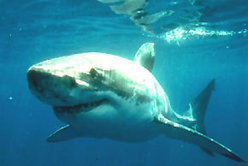
The Great White Shark or affectionally known as the "Great White" belongs to a group of sharks named Mackerel Sharks. Its common name was derived from the shark's white underbelly. They are solitary animals, but have also been reported to swim in pairs or groups. They are found on all coasts of Australia, and furthermore throughout the World.
They range between 3.5 to 5 metres long, and weigh on average 1,300kg. The females are large than males. The Great White is grey in colour from the top, and white underneath. They have on average 2,800 teeth in their mouth, all in rows and triangle in shape. They are slanted on an angle inwards, which helps keep hold of their prey. Being predatory animals, they feed on other fish, including other sharks. They can even tackle small whales. Amazing Fact: Great White's also eat animals that are already dead. They attack their prey once, and then wait and let their prey bleed to death. They have an amazing sense of smell, and can pick up blood in water a long way away. This helps them to track down their prey, or potential prey. Amazing Fact: Shark's need to swim, or they will sink! The Great White is constantly swimming, or it will begin to drop in the ocean. |
|
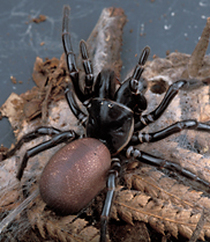
Funnel-webs are large black spiders with a shiny head/thorax. The body may range from 1.5 cm up to more than 5 cm long depending on the species.
Female funnel-web spiders are stockier than males, with shorter legs and a bigger abdomen, which may be brown or bluish. The eyes are small and closely grouped, the fang bases extend horizontally from the front of the head and the long fangs lie parallel underneath (do not check this on a live spider!). Funnel-web spiders live in burrows in sheltered positions in the ground, or in stumps, tree trunks or ferns above the ground. Their burrows are lined with a sock of opaque white silk and several strong strands of silk radiating from the entrance. |
|
|
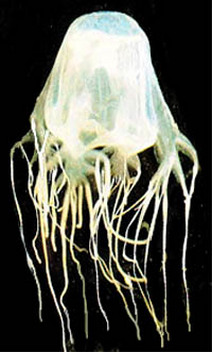
The Box Jellyfish (also known as a Sea Wasp) is a very dangerous creature to inhabit Australian waters. The Jellyfish has extreme toxins present on its tentacles, which when in contact with a human, can stop cardio-respiratory functions in as little as three minutes.
This jellyfish is responsible for more deaths in Australian than Snakes, Sharks and Salt Water Crocodiles. The creature has a square body and inhabits the north east areas of Australia. The tentacles may reach up to 80 cms in length. It is found along the coast of the Great Barrier Reef. This deadly species of jellyfish is related to another deadly jellyfish, the irukandji jellyfish. |
|
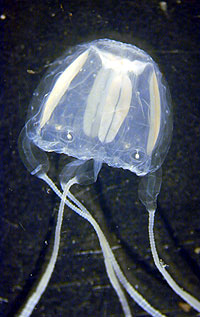
The Irukandji (Carukua barnesi) inhabits Northen Australian waters. This is a deadly jellyfish, which is only 2.5 cenimetres in diameter, which makes it very hard to spot in the water.
This is a species of jellyfish which has become known about in recent years, due to deaths of swimmers in Australia. In 2002, Richard Jordon was stung whilst swimming off the coast of Hamilton Island. He was a 58 year old British tourist, unfortunately he died a few days later. This deadly species of jellyfish is relater to another deadly jellyfish, the box jellyfish. Amazing Fact: The Irukandji jellyfish is only 2.5 centimetres in diameter, but can cause death to humans within days. |
|
This information has been taken from www.australianfauna.com
